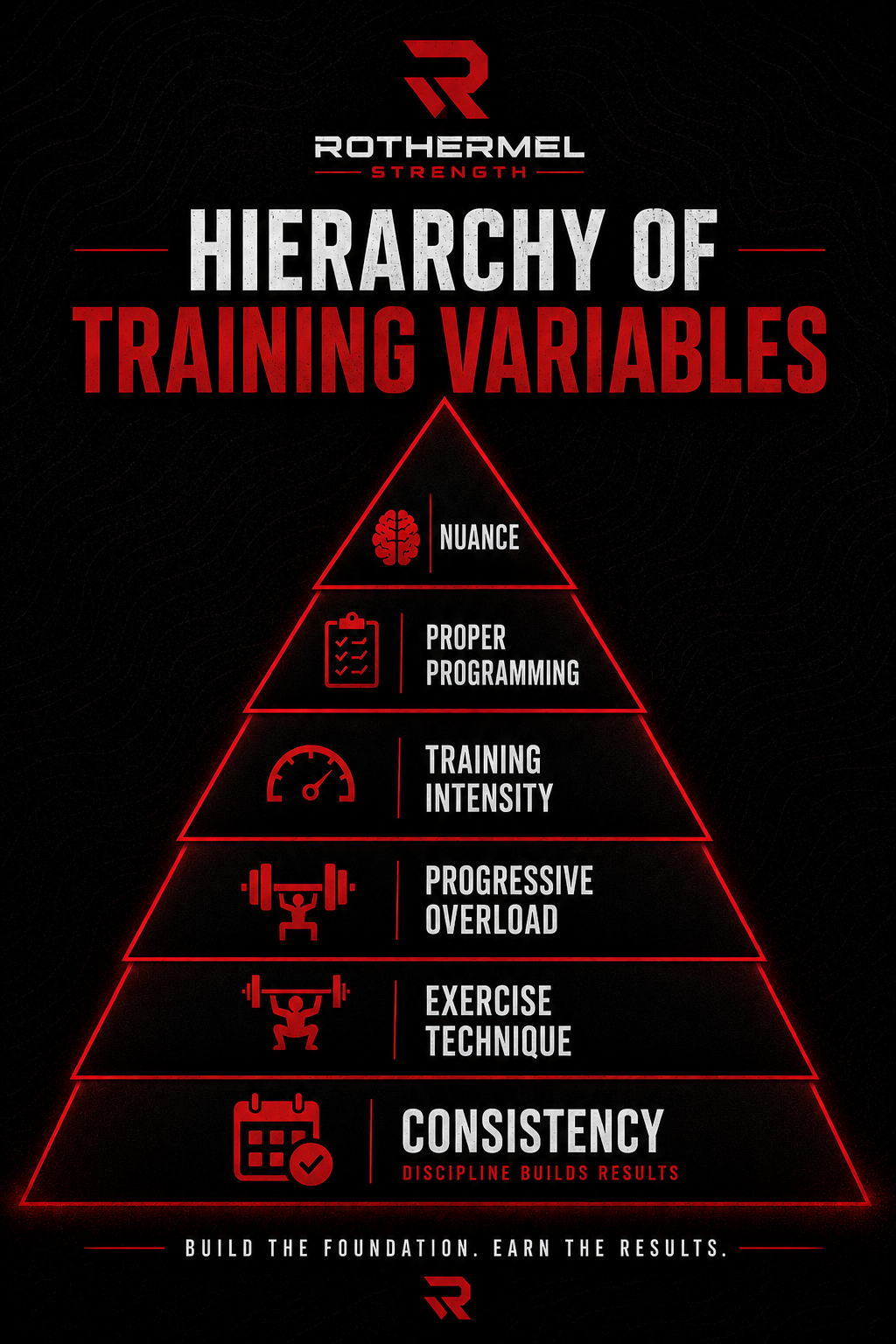
Hierarchy of Strength Training Variables
Building a house and building a strong and powerful body have something in common, which is the importance of laying a strong foundation to build upon. When an individual first falls in love with strength training it's easy and common to get excited about where to put the big screen TV and the hot tub but in reality, the most important thing to focus on is ensuring the concrete and frame is laid correctly because if there are cracks in the foundation or the frame is crooked, all the window dressing in the world won’t prevent your house of iron from crumbling to the ground. In the world of strength training, there aren't TV’s and furniture to design like a house but rather there are a million ways to design training programs which can get people into more trouble than picking the wrong color paint or curtains. The things that will allow you to transform your body from a pencil neck, paper pushing desk jockey to a brick house are not flashy or exciting. It’s old school basics done well.
CONSISTENCY
The first basic strength training principle that needs to be accomplished is consistency. No matter what program you decide to perform, if you aren’t consistent with showing up when you’re supposed to, nothing will work. I’m going to steal this phrase from Marc Lobliner of Tiger Fitness because I love it so much, “Nothing Works Unless You Do”. I love this phrase because it’s true. I’m not advocating for 7 days a week/365 days a year training, I’m advocating for doing the work on a consistent basis. If you cannot be consistent, it’s impossible to do what we call “train”. Instead, your exercise becomes workouts. There’s nothing wrong with either but there is a huge and clear difference. Training for anything, strength, hypertrophy, athletics, etc., requires a consistent weekly effort with pre-programmed ideas and concepts which build upon itself throughout a training period, season, or year. When you are unable to be consistent, no matter how great your plan is, it will be impossible to execute because of the lack of consistent work.
Being consistent also requires you to be honest with yourself. If you choose a program that requires 5 days of exercise and the workouts take 1-1.5 hours to complete, but you can only workout 3 days a week for 45-60 minutes, that program isn’t for you and you will, by default, be inconsistent because it doesn’t fit your life schedule. Before you start a new program, have an honest conversation with yourself about your goals and what time commitment is realistic. Choose a program that is realistic for you and your current situation.
EXERCISE TECHNIQUE
There is no way around mastering technique. It is an absolute must in the strength training world. If your technique is poor it will increase the risk of injury - which will drastically reduce your performance. As the saying goes, “the best ABILITY is availABILITY”. If you are constantly injured, there is no way to make progress. Instead you will actually regress! And if you are able to avoid injury, you will still likely experience reduced performance capabilities using poor technique because proper technique ultimately in the long run allows for increased strength and output. Using correct exercise technique puts the body in an ideal position to maximize results and reduce injury. If you are new to strength training, learning the proper technique right away is obviously the best option. If you are experienced and have been using a certain technique for a long time, having to re-learn new movement patterns can make people a little hesitant and resistant because there is a time period where the weights will likely need to decrease to practice something new. It creates this 1-2 steps backward scenario but it ultimately allows for 5 steps forward - big progress in the long run.
And just briefly on the technique concept I want to make a point that strength training is not always about blasting through walls and hitting PRs every week. There are many times when you go into the gym, “practicing” a movement and building a skill is the most important thing.
PROGRESSIVE OVERLOAD
Once consistency and technique are established, it is important to make progress on a regular basis. Progress in strength training has a vocabulary word called progressive overload which is a very basic concept where you do more than you previously did in some capacity. This could mean more weight, more reps, more sets, less rest, etc. There are many ways to increase the difficulty of your training over time. Even if you’ve never heard of the term, “progressive overload” you most likely already know that in order to make progress in any activity or pursuit you must find a way to continually get better, which means pushing yourself to new limits. This is a foundational idea and just as important in building a strong and powerful physique right after consistency.
INTENSITY
The next most important concept on the hierarchy of training variables is intensity. Some of the smartest people in strength training, who design the perfect program down to the most minute details never make significant progress and the reason for this is because they lack the animalistic intensity required to become a true savage in the iron jungle. Then there are those in the iron jungle, a different breed, one less tame, one less scientific, who have no knowledge of proper programming or principles of periodization but lift with violent aggression on a weekly basis and become a true king of the jungle. Why? Intensity. Proper programming is the fastest way to get from point A to point B but 100% intensity, progressive overload, and consistency has proven to result in significant strength which is why intensity is the third most important strength training variable. There is no substitute for hard work and if you put in the work, you will see the fruit of your labor. But without proper programming, you will be capped at a certain point and fail to continue to progress and may be more likely to experience injury. This sometimes results in extremely strong individuals who become a “flash in the pan” due to chronic injuries.
PROPER PROGRAMMING
Proper programming will allow you to get to the final destination in a much faster and most likely, less injurious way. It is not an overstatement to say that proper programming will shorten the time to maximum strength levels by years. Knowing how to program on an individual basis based on goals, strength training age, injury history, and many other factors, will be a huge propelling force to achieve your strength training goals. How often to train a movement, when to push the limits, when to take it easy or extra rest, exercise selection and order, and a hundred other things will impact your progress over time.
A big mistake people often make when it comes to training is not having a proper plan to get stronger over time. Many people walk in the gym and blast off with their training week after week with no concept of how progressive overload works. Progressive overload involves thinking weeks and months, sometimes even years down the road and looking at what is possible at that point and how to get there. For example, you have a competition or a gym training goal you want to achieve in 3 months. How do you achieve that goal? Do you just hammer the piss out of your training every week and hope that you get to the destination? Or do you come up with a plan that progressively overloads your training in the specific ways that it needs it to achieve a goal?
Strength is not something that can be achieved in a day, week, or even a year. Those who reach the highest levels of strength do so over the better part of a decade or more. This time table requires an individual to stay mostly injury free in order to train consistently at a high level. Proper programming will help to drastically reduce the risk of injury and increase performance over a long period of time.
NUANCE
After you’ve mastered the first five variables in successful strength training, it is now time to add in some dessert and fun. This is where the nuances of training come in such as cluster sets, drop sets, changes in tempo, negatives, pauses, etc. There is no point in employing these advanced techniques until you are 1) consistent, 2) mastered your technique, 3) progressively overload your training, 4) bring enough intensity to light up the gym, and 5) have proper programming on a weekly and monthly basis. By adding sprinkles to an otherwise non editable strength training diet, you will still be eating something that tastes like absolute garbage. Sprinkles are only good on something that has already been made to perfection like smooth, rich, creamy ice cream. Adding sprinkles to a pile of dog shit is still dog shit.
Like I said in the beginning of this article, master the basics and you will go far. The first five concepts in my strength training hierarchy are not flashy or exciting at all. They are as boring as watching paint dry on your house of iron. But you can’t have a big beautiful house without a strong foundation. Of course after you’ve done all the electric and plumbing, it’s time to put a little pizazz and individual nuance that makes your house a home. Each of us as individuals has a preference and method(s) that work best for us. Learning to incorporate your individual needs is what makes your house a home – an iron dome of strength. Be consistent, progress your training, master your technique, bring the intensity, program correctly, and then add some nuance and detail to have some fun. There is not one way to achieve strength, there are multiple paths along the same road so find a method that works for you, that you enjoy, and do it for a long period of time. Do this, you will become a strength master.